The Biosphere Reserve
What is a biosphere reserve?
The biosphere is the thin layer surrounding the planet, roughly 30 kilometres wide, that encapsulates all life on Earth. Within this thin layer, nature and humans should be able to coexist in a way that does not disrupt the ecological balance. This is the objective of all Biosphere Reserves in the world: How do we, as humans, achieve positive social development, without wasting the Earth’s natural resources?
All Biosphere Reserves in the world must fulfill three functions; to conserve, develop and support the area in which they operate:
- Conservation – to conserve natural diversity, cultural heritage, and the traditional cultural landscape.
- Development – to promote the ecologically, and socioeconomically, sustainable development.
- Support – to support development projects, education and training, research and monitoring that contribute to a sustainable development locally, regionally, nationally and internationally.
Biosphere Reserves consist of three geographical zones with varying degrees of human activity.
- Core area Strictly protected ecosystems dedicated to conserving the biodiversity of habitats and species.
- Buffer zone Areas surrounding or adjacent to core areas, where activities compatible with conservation are encouraged. It serves to mitigate disruptions from the transition area.
- Transition area The outer area of the site where communities live and work, promoting sustainable economic and human development.
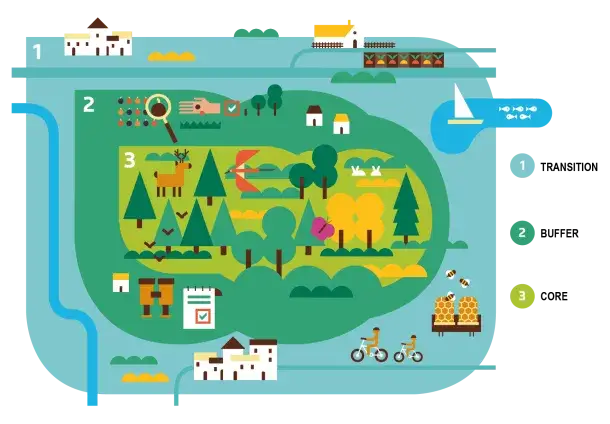
By surrounding the core area with the activities of the two outer zones, we can control the impact of external disturbances, as well as utilize, without destroying, the nature and cultural values which are preserved within the core area.