Background
How the Biosphere Reserve was created
The idea of establishing biosphere reserves in Finland began to take shape in the late 1980s. Finland was already a member of UNESCO’s Man and the Biosphere (MAB) programme, and a working group of researchers and experts from the Ministry of the Environment was set up to plan the establishment of Finland’s first biosphere reserves. One biosphere reserve was planned to represent the boreal coniferous forest belt, the taiga, and with that the North Karelia Biosphere Reserve was established in 1992. Another biosphere reserve was intended to represent the coast and archipelago, and the Archipelago Sea area around the Archipelago Sea National Park was chosen for this purpose. An application to establish the biosphere reserve was submitted to UNESCO once the relevant municipalities had given their approval, and the UNESCO Archipelago Sea Biosphere Reserve was established in 1994.
Initially, the biosphere reserve covered the municipalities of Nagu, Korpo, Houtskär and Dragsfjärd, i.e. the municipalities closest to the Archipelago Sea National Park. The biosphere reserve included Houtskär in its entirety, Korpo and Nagu with the exception of the main islands, and the Dragsfjärd archipelago that was accessible by ferry. About 15 years later, in 2010, the biosphere reserve was expanded based on a proposal from the municipalities, to include Iniö, the main islands of Nagu and Korpo, as well as the parts of the archipelago within Västanfjärd and Kimito. The new border included all islands accessible by ferry or boat in the Town of Pargas and the Municipality of Kimitoön. Since then, Lövö bridge has replaced the Lövö ferry, but the islands of Lövö and Kasnäs remain part of the biosphere reserve.
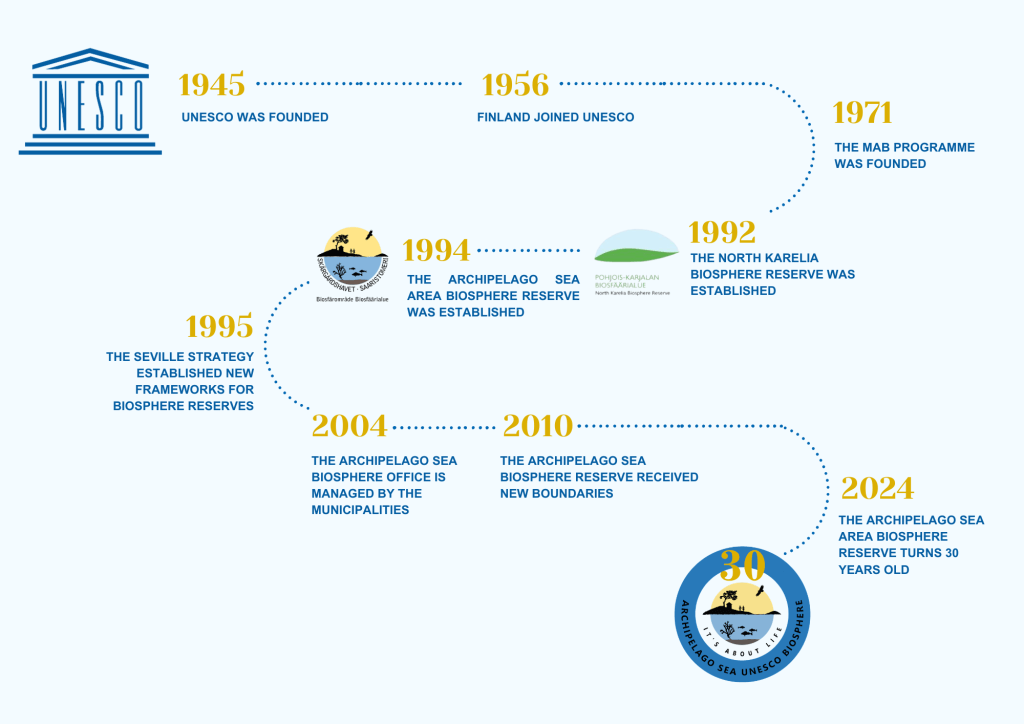
OUR STORY – the making of a biosphere reserve
The culture of the archipelago has always been characterized by the sea and the islands. The landscape has been affected by livestock grazing on the islands for centuries, which has kept them free from denser vegetation. Cultural landscapes have a high biodiversity. Even today, the archipelago is one of the most species-rich areas in Finland.

After World War II, the archipelago’s population and economy underwent major changes. Agriculture evolved from small-scale and self-sufficient to large-scale and market-controlled, which did not suit the scattered archipelago landscape. Ferry traffic in the area expanded, but despite better communications, the island population declined sharply, especially on the smallest islands. When population and land use decreased, so did biodiversity. The state of the sea has also significantly deteriorated, due to the release of nutrients from both agriculture and society.
In the 1970s, solutions were sought to preserve the rich nature of the archipelago. As a result, the Archipelago National Park was founded in 1983. The elder-flowered orchid (in Swedish Adam and Eve) was chosen as a symbol for managing the meadows of the archipelago, since one of the last populations was saved on the island of Jungfruskär. Today, the orchid is thriving on the island, but is otherwise rare.
Preserving the archipelago’s nature values is, of course, much more than saving one plant population. A rich and diverse nature is a prerequisite for a prosperous society. The ecological, social and economic values have, since the Archipelago Sea was named a Unesco Biosphere Reserve in 1994, been strongly interconnected. The traditional local knowledge of the sea and the archipelago nature, as well as decades of research in the area, provides a good basis for developing sustainable solutions for the archipelago, both today and in the future.
Change is a constant, both natural changes and changes caused by man. In order to promote a viable archipelago, we must find sustainable solutions adapted to the situation today and to the future. To slow down depopulation, it is important to find new ways of working in the archipelago. The opportunities that tourism and new trends in food production bring are of great importance.
All our activities have a strong impact on the sea and its state. Everyone in the region has an influence on the condition of the Archipelago Sea and takes responsibility for their own actions and the trails they leave behind. Through collaboration, we build a sustainable society. We are all part of the biosphere!
30 years of biosphere activities
1994- 2003
The Archipelago Sea Biosphere Reserve’s first decade was dedicated to establishing its role and mission. The Southwest Finland Regional Environment Centre managed the coordination and the coordinator was temporarily based at Kompassen in Nagu. The focus was on developing a sustainable organisational structure and operating model for the biosphere reserve. Comprehensive efforts were made to open up the concept to key stakeholders and local people, and together they set up projects and activities that showcased the purpose of the biosphere reserve. The uncertain funding for coordination and operations made the work challenging and the biosphere reserve was at times without a coordinator. The projects were implemented by various large organisations.
Examples of activities
The biosphere reserve was central to Agenda 21 activities, which helped the municipalities to develop in a sustainable direction. In 2000, future visions for the Turku archipelago were developed in collaboration with the Centre for Lifelong Learning at Åbo Akademi University and the Centre for Extension Studies at the University of Turku. In 1995 the Sustainable development plan for the Archipelago Sea Biosphere Reserve was developed by the Centre for Extension Studies in University of Turku. The Archipelago Sea served as the venue for two major international biosphere conferences. Pro Åbolands utskär rf was founded in 1999 as a co-operation body for the inhabitants of the outer archipelago. It also served as a reference group for the biosphere reserve. The association laid the foundation for the National Association of Finnish Islands (FÖSS), which was established in 2007.
2004- 2013
By the biosphere reserve’s second decade, clear operating principles and themes tailored to the area had already been established. The Southwest Finland Regional Environment Centre, which was responsible for the coordination of the biosphere reserve, entered into an agreement with Region Åboland rf on cooperation to coordinate activities. This gave the municipalities a central role in the operations and they continued to manage the biosphere office. The biosphere reserve activities already included many organisations and new models of participation began to emerge. The educational activities were started.
Examples of activities
The biosphere reserve was involved in designing the Pro Archipelago Sea programme for several years. The Åbolands Skärgårdsstiftelse (‘Åboland Archipelago Foundation’) was established in 2008. The foundation, in close co-operation with the biosphere reserve, runs activities to promote a viable archipelago. Several projects were implemented to support cooperation and entrepreneurship related to the management of cultural biotopes. The concept of ‘the Pike and his Friends’ came about in 2009 to increase the participation of the youngest children in the town, as well as to create a sense of community for children in early childhood education in the new municipality of the Town of Pargas. ‘The Pike and his Friends’ was developed in cooperation between the biosphere reserve and early childhood education into a operating model for sustainability education. “The Biosphere Reserve in Schools” was the first annually recurring activity of the biosphere reserve in co-operation with basic education. It began in 2009 when seventh grade pupils from the schools in the biosphere reserve travelled to Boskär and Yxskär in the Archipelago Sea National Park. The annual “Winter Meeting” was launched in 2010 at Archipelago Centre Korpoström. The establishment of food crafts in the region started with a Winter Meeting in 2011. Subsequently, many regional and national projects have been realised, laying the foundation for food crafts in Finland.
2014- 2023
Over the past decade, the biosphere reserve has invested heavily in both educational activities and participation through its biosphere ambassador and biosphere partner programmes. The organisation and activities of the biosphere reserve are characterised by various forms of cooperation. The biosphere office is managed by the Town of Pargas in collaboration with the Municipality of Kimitoön and the ELY Centre for Southwest Finland. The biosphere reserve now has its own educational programme, the Biosphere Academy, which aims to strengthen children and young people’s sense of belonging and their capacity to act for a sustainable future. There has been more focus on the role of the biosphere reserve in providing people, businesses and organisations with the context, knowledge and tools to take action for a sustainable future. There is now also more focus on raising the profile of the UNESCO biosphere reserve as a valuable status for the area.
Examples of activities
The project ”We are all part of the biosphere’ promoted the visibility of and participation in the biosphere reserve in the context of the 2014 anniversary year. The Kids’ Lab started in 2016 with the project ‘Our Archipelago Sea’, which was realised by FÖSS rf in cooperation with the biosphere reserve. The biosphere reserve has continued to develop and run the Kids’ Lab at Archipelago Centre Korpoström. The project “Food of the Coast” led to the further development and establishment of the food crafts concept throughout Finland. Today, the promotion of food crafts is carried out by the association Mathantverk i Finland rf. The Biosphere Partners Program has been running since 2019 and currently includes 18 organisations and companies. The Biosphere Ambassador Program has also been running since 2019 and so far 57 Biosphere Ambassadors have been trained through two training programs.